Nursing Degree Options
 Click image to enlarge
There are many nursing degree options. Each option will lead you to a different type of nursing career. Explore entry-level nursing degree options, bridge nursing education degree options, graduate nursing degree options, and pathway options, depending on the type of career you want to achieve.
Click image to enlarge
There are many nursing degree options. Each option will lead you to a different type of nursing career. Explore entry-level nursing degree options, bridge nursing education degree options, graduate nursing degree options, and pathway options, depending on the type of career you want to achieve.
Entry-level Degree Types
Certified Nursing Assistant (CNA) - A short certificate program (a few weeks) offered at community colleges and vocational schools. It's the fastest way to start working in healthcare.
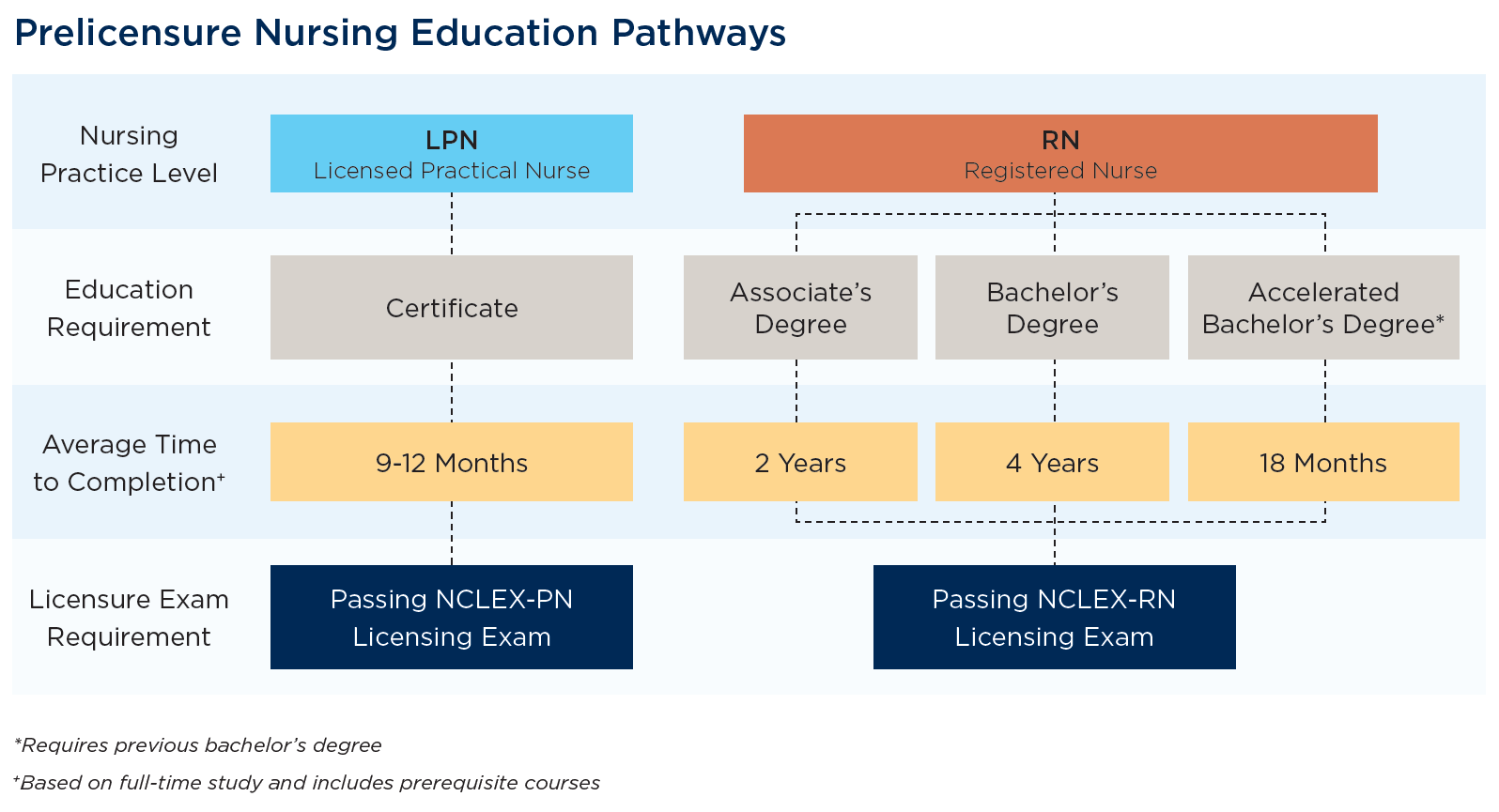
Practical Nurse (PN) - LPN programs run 9–12 months through community colleges or technical schools. When you finish your program, you will be eligible to take the NCLEX-PN exam and gain your license as a Practical Nurse. This is a good option for those who want to enter the workforce quickly before potentially bridging to RN.
Associate Degree in Nursing (ADN) - ADN programs are a two-year pathway that prepares students to become Registered Nurses. When you finish your program, you will be eligible to take the NCLEX-RN exam and gain your license as a Registered Nurse. Kansas has several community colleges with strong ADN programs with high NCLEX pass rates.
Bachelor of Science in Nursing (BSN) - A BSN requires four years of study and is a solid foundation for pursuing graduate-level nursing degrees. Many Kansas employers prefer BSN-prepared nurses. . When you finish your program, you will be eligible to take the NCLEX-RN test and gain your license as a Registered Nurse.
Common Program Formats
Nursing programs can be set up in a variety of formats.
- 1+1 PN and ADN Programs: A 1+1 nursing program in Kansas is a two-year pathway that enables students to earn an Associate Degree in Nursing (ADN) in two phases: practical nursing (PN) during the first year and ADN in the second. Students must obtain PN licensure before progressing to the ADN portion of the program. Admission and application processes are separate for the PN and ADN components.
- Bi-level PN/ADN Program: Students learn both PN and ADN content from the beginning of the program. They can choose to stop early, take the LPN licensure exam, and become a licensed practical nurse (LPN). Or they can continue through the full ADN program and become eligible to take the RN licensure exam. One benefit of bi-level programs is that students only apply once to complete both the PN and ADN programs.
- Traditional BSN Program: Programs are typically 2 years of study with nursing courses taken throughout.
- 2+2 BSN Program: Students complete two years of general education/prerequisite coursework at a community college followed by two years of nursing coursework at a four-year university, resulting in a BSN degree.
- Entry-level BSN Program: Traditional programs are typically four years of study, with nursing courses often taken in the third and fourth years.
- Accelerated BSN: Programs are often geared toward career-changers or those seeking a second degree and require previous college credits to complete a BSN program in a short amount of time.
Common Bridge Programs Types
Bridge programs are offered at nursing schools throughout Kansas to help students with previous healthcare experience “bridge” their nursing education. Created with working professionals in mind, they build on students’ professional experience and prior education, often awarding credit for previously taken prerequisite coursework.
- Paramedic to RN programs help paramedics transition into the nursing profession and RN role by earning an ADN.
- LPN to RN programs help LPNs advance to an RN role by earning an ADN or a BSN.
- RN to BSN programs support RNs who have an ADN advance their degree to a BSN.
Regardless of the type of nursing education program a person chooses, students must pass a licensing examination before working as LPNs or RNs.
Doctor? Nurse? Or Something else?
Healthcare professionals are in demand in Kansas. And all treat patients as part of a healthcare team. But they practice healthcare differently. Check out these basic differences to see what might be a better fit for you.